

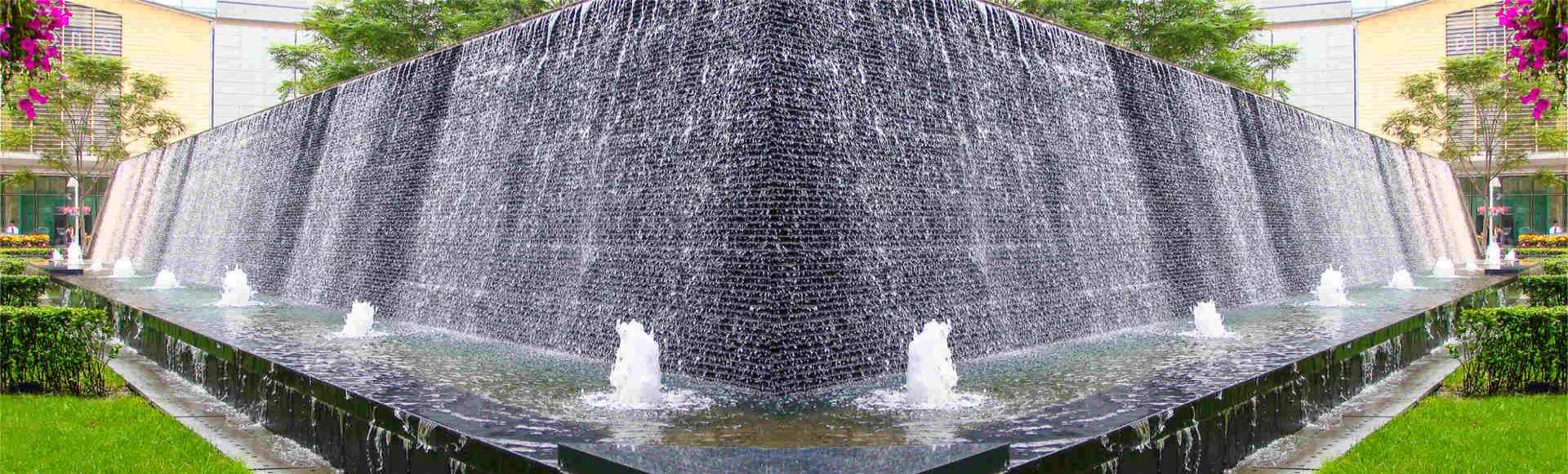

A water curtain wall, as a star element in modern architecture and landscape design, is not merely a simple flowing water surface, but a sophisticated system integrating fluid mechanics, material mechanics, and spatial aesthetics. Its core design principles are built on two foundations: gravity-driven uniform water distribution technology and surface tension control. Through scientific structural design, it achieves continuous, uniform, and silent water flow, breaking away from the noise and disorder of traditional water features.
From the perspective of fluid mechanics, the core of a water curtain wall lies in the uniform flow trough design. The top water collection chamber converts high-pressure water flow into low-speed laminar flow through precision-machined linear weirs, allowing the water to spread naturally along the curtain surface under gravity, forming a stable water film with a thickness of 0.5–2 mm. This process strictly follows Bernoulli’s equation. By controlling the width of the outlet, water pressure, and wall roughness, the design avoids flow interruption, splashing, or turbulence. In professional design, the flatness error of the weir must be controlled within 0.1 mm to ensure uniform water discharge per centimeter of width—this is the key to achieving a “mirror-like flow” effect.
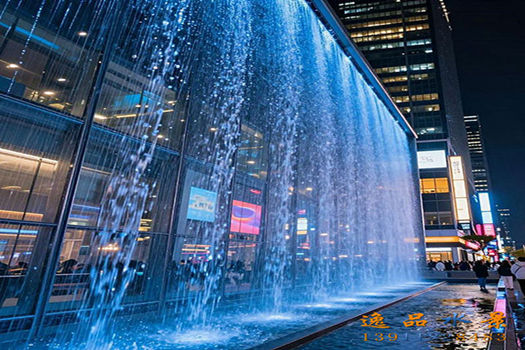
The application of physical mechanics is also reflected in noise reduction and steady-flow design. The water curtain wall uses a flow deceleration buffer structure to convert high-speed water flow into low-speed wall-adhering flow, reducing running water noise at the source. Meanwhile, the wall adopts a slight inclination design (usually 85°–88°), combined with surface grooving technology, to enhance the adhesion between water flow and the wall surface using the principle of fluid attachment, preventing water curtain deformation caused by wind interference. For large outdoor water curtain walls, a wind-resistant diversion system is also introduced. Through the bottom water collection tray and side windshields, interference from winds above level 3 is minimized to ensure the integrity of the water curtain.
Modern water curtain wall design also incorporates an ecological fluid concept, combining the water circulation system with fluid dynamics to realize recycled water use. Pump selection strictly follows system resistance calculations, combined with variable frequency control technology, dynamically adjusting flow according to the height and width of the water curtain. This not only ensures a stable water film but also reduces energy consumption. Such design principles achieve visual aesthetics while balancing energy conservation, environmental protection, and user experience, making the water curtain wall a spatial decoration with both technological and artistic vitality.
The design principle of the water curtain wall is a cross-border integration of science and art. With fluid mechanics as its skeleton and aesthetic design as its flesh and blood, it endows cold architectural walls with vivid vitality. Whether it is a giant water curtain in a commercial complex or a small waterscape in a home entrance, all rely on this core principle to create a quiet and elegant spatial atmosphere, becoming an irreplaceable classic element in modern design.
 Hot news
 Lighting Design of Water Curtain Walls – Interweaving Light and Shadow for a Nighttime Visual Feast
What materials are used for water curtains
How to design and select a suitable style of water curtain wall landscape in office lobby decoration
Design elements of courtyard garden water feature wall | Functional analysis of water feature wall
Analyzing the symbolism of the entrance water curtain wall | Feng Shui of the water curtain wall
Common malfunctions and maintenance methods of water curtain walls
Advantages of water curtain wall landscape manufacturers
How to choose a water feature design and construction manufacturer | Choose a water feature company
 Contact Us
WhatsAPP:+86 13911828483
Phone:+86 13911828483
Email:we @ i8c.cc
Address:Beijing, China


